With the rapid advancement of AI glasses and other smart wearable devices, the convergence of the traditional optics industry and consumer electronics has become inevitable. However, these two sectors differ fundamentally in design philosophy, manufacturing standards, supply chain logic, and cultural DNA.
By deeply understanding these differences and building effective integration bridges, companies can break through industry barriers and create products that balance optical excellence with advanced electronic experiences. This is also the core logic behind EmdoorXR’s differentiated competitiveness.
At its core, the glasses industry is defined by “fashion + optometry.” Since consumers still rely on in-store fittings and vision tests, offline channels have always been central to the purchasing process. This fundamental dynamic is unlikely to change, even as AI capabilities are integrated into glasses. Physical stores will continue to play a vital role in the smart glasses era.

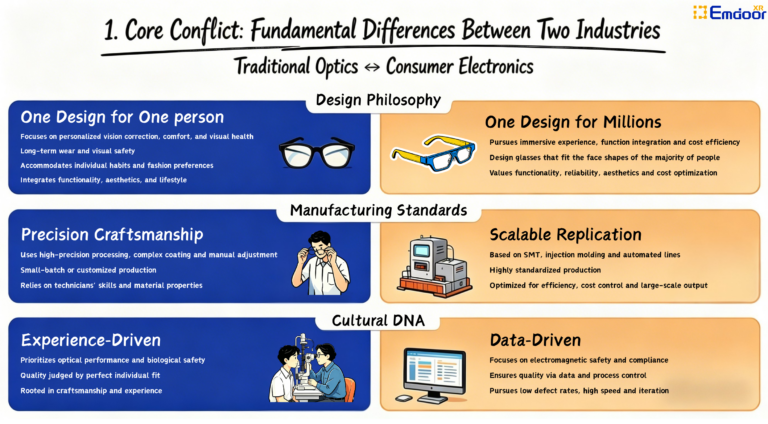
Core Conflict: Fundamental Differences Between Two Industries
From underlying logic to practical execution, traditional optics and consumer electronics operate as two almost entirely distinct systems. Direct integration without proper adaptation often leads to significant challenges.
1. Design Philosophy: “One Design for One person” vs. “One Design for Millions.”
Traditional Optics:
Focuses on personalized vision correction, wearing comfort, and visual health. It is built around ergonomics, optical performance, and biocompatibility, pursuing a “one design for one person” customized solution to support long-term wear and visual safety.
At the same time, it emphasizes the harmony between optical functionality, eyewear aesthetics, and individual lifestyle scenarios—ensuring users can “wear comfortably, see clearly, and use it long-term.”
Consumer Electronics:
Centers on immersive experiences, functional integration, cost efficiency, and rapid iteration. Built on sensors, computing power, and industrial design, it emphasizes standardized platforms and scalability—”one design for millions”, dedicated to creating glasses suitable for the majority of people. Core metrics include functionality, reliability, acceptable aesthetics, and optimal cost.
2. Manufacturing Standards: Precision Craftsmanship vs. Scalable Replication
Traditional Optics:
Relies on high-precision lens processing, complex coating technologies, manual adjustments, and customized production. Typically involves small-batch or even single-unit manufacturing, with strong dependence on technician expertise and material characteristics.
Consumer Electronics:
Built on SMT assembly, precision injection molding, and automated production lines. It is highly standardized and optimized for efficiency, cost control, and large-scale manufacturing.
3. Cultural DNA: Experience-Driven vs. Data-Driven
Traditional Optics:
Focuses on optical performance and biosafety, with “perfect individual fit” as the primary standard. It places great importance on the wearer’s personal habits, usage preferences, and fashion attributes, while emphasizing craftsmanship and the accumulation of experience.
Consumer Electronics:
Focuses on electromagnetic safety and regulatory compliance, using data and process control to ensure quality. Targets extremely low defect rates, with strong emphasis on speed and iteration.
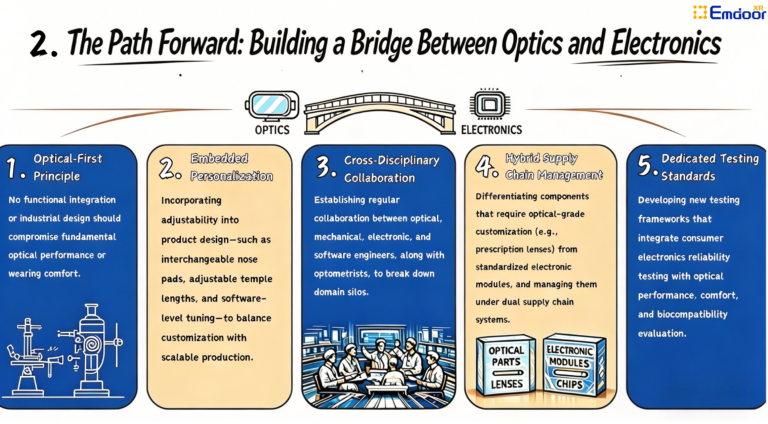
The Path Forward: Building a Bridge Between Optics and Electronics
These differences are not irreconcilable. EmdoorXR addresses them through integrated innovation, establishing five key principles to combine the strengths of both industries.
1. Optical-First Principle
No functional integration or industrial design should compromise fundamental optical performance or wearing comfort.
2. Embedded Personalization
Incorporating adjustability into product design—such as interchangeable nose pads, adjustable temple lengths, and software-level tuning—to balance customized fitting needs, fashion expression, and scalable production. This enables AI glasses to satisfy both optical adaptation and personal style.
3. Cross-Disciplinary Collaboration
Establishing regular collaboration among optical, mechanical, electronic, and software engineers, along with optometrists, to break down domain silos.
4. Hybrid Supply Chain Management
Differentiating components that require optical-grade customization (e.g., prescription lenses) from standardized electronic modules, and managing them under dual supply chain systems.
5. Dedicated Testing Standards
Developing new testing frameworks that integrate consumer electronics reliability testing with optical performance, comfort, and biocompatibility evaluation.
Integration Is Not Addition, but Reconstruction
The convergence of optical craftsmanship and consumer electronics is not a simple layering of features—it requires a fundamental reconstruction of design logic, manufacturing standards, and quality systems.
EmdoorXR’s approach demonstrates that only by:
- grounding products in optical excellence,
- leveraging consumer electronics as the delivery platform,
- and balancing personalization with scalability, precision with efficiency,
can truly user-centric AI glasses be realized.
This path of integrated innovation is not just a solution—it represents a new direction for the future of the industry.